The Ghost in the Workshop
There's a question that doesn't get asked enough about how knowledge disappears.

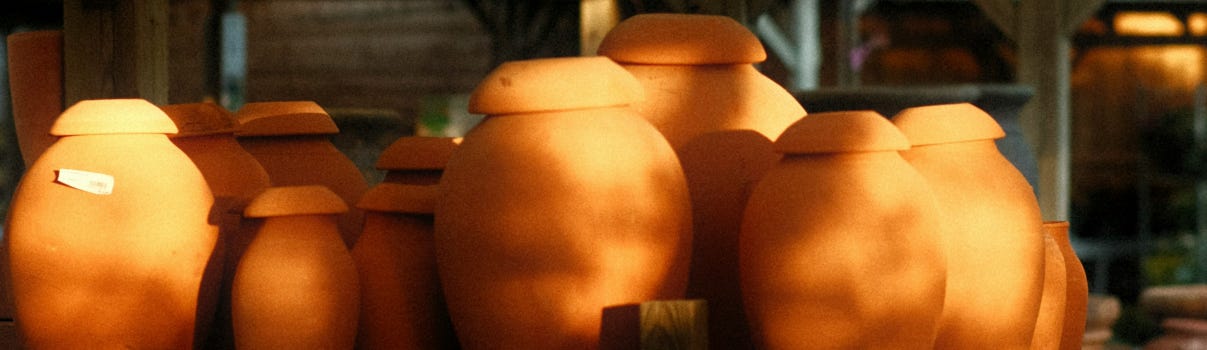
There's a question that doesn't get asked enough about how knowledge disappears. Most people assume it happens through destruction. Someone burns the library, bans the book, kills the teacher. And sometimes that’s true. But the more common way knowledge dies is quieter and harder to see. The economic and material conditions that made the knowledge useful simply change. And once those conditions are gone, the skill becomes a ghost. Still technically possible. Just no longer viable. And within a generation, forgotten entirely.
I started thinking about this after reading Bryan Ward-Perkins’ book on the fall of Rome. His argument isn’t primarily about barbarian invasions or political collapse. It’s about pottery. And roof tiles. And the financial infrastructure that made sophisticated everyday goods possible across an entire empire. When that infrastructure collapsed, it didn’t matter that people still knew how to make high quality ceramics. The kilns needed specialized fuel. The fuel needed stable supply lines. The supply lines needed roads and trade networks and a consumer base wealthy enough to buy the product. Remove any piece of that chain and the knowledge becomes useless. Not because it was forgotten. Because the scaffolding that gave it purpose was gone.
The generation that lived through the collapse still remembered how things used to work. Their children heard stories about it. Their grandchildren didn’t even know what had been lost.
I came across something similar in my Latin American reading — a description of an indigenous group attempting to replicate Spanish roof tiles after contact and failing. Not because they were incapable. But because they didn’t have access to the full production ecosystem that made those tiles possible. The technology transfer failed. And shortly after, European disease devastated them entirely. The material evidence tells you what’s actually happening on the ground, and it’s often a harder story than the grand narratives want to admit. A people trying and failing to reproduce foreign ceramics is not a culture being gently transformed. It’s one being overwhelmed.
I recognize this pattern because I see it in my own trade. I work in construction, and I’ve watched the last generation of plasterers who can do real lath and plaster work, or hand-run plaster of paris crown moulding, age out with almost nobody coming up behind them. The skill isn’t lost because nobody wrote it down. It’s lost because the economic scaffolding that made it viable disappeared. Drywall is cheaper, faster, and good enough. So the knowledge becomes a ghost.
It’s the same with furniture. I’ve met woodworkers who know joinery techniques that go back centuries. Mortise and tenon variations, hand-cut dovetails, methods that evolved over generations of craftsmen refining what worked. The changes in just the last 500 years from those techniques to modern fasteners and composites are staggering. And the old guys who still know how to do it aren’t training replacements because the market won’t pay for it.
Even keeping older machines running is becoming a dying art. There are mechanics and technicians out there holding entire fleets together with knowledge that exists in their hands and nowhere else. When they retire, that knowledge retires with them.
Ward-Perkins would recognize all of this immediately. It’s the same pattern across centuries and continents. The sophistication doesn’t vanish because people get stupider. It vanishes because the economic and material conditions that sustained it change. And once the last generation that carried it is gone, the next one doesn’t even know what it’s missing.
I think about this a lot when I look at history. We focus on the dramatic collapses. The sackings, the conquests, the plagues. But the real loss happens in workshops and kilns and on scaffolding, where the last person who knows how to do something properly finishes their last day of work and nobody picks up the tools.
What I’m left wondering is whether this pattern is universal, or whether it’s specific to moments where one culture is being absorbed or overrun by another. And whether the same diagnostic tools that Ward-Perkins uses for Rome could be applied to other transitions. Because if you can read the health of a civilization through its pottery, that should work anywhere. The question is whether anyone has done it as rigorously for what came after Rome in the East.