The Thing That Used to Walk
Everyone knows the oldest story on earth. Almost nobody has looked at what it actually says about the one who ruined it.

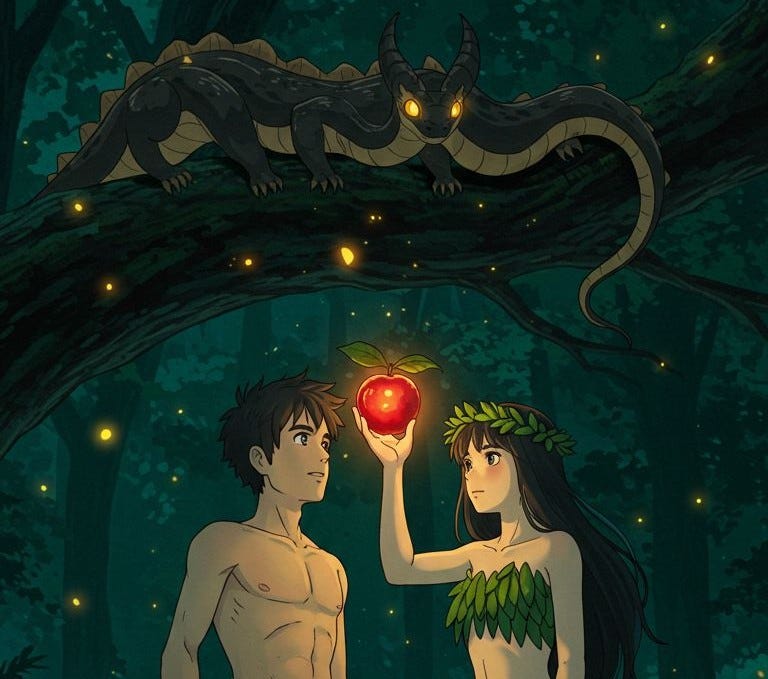
There is a sentence in the third chapter of Genesis that should stop you cold, and it almost never does, because we have heard it so many times that we have stopped hearing it at all.
“On your belly you shall go, and dust you shall eat all the days of your life.”
Read it again, slowly, like you have never seen it. That is a sentence about a change. You do not tell a fish it will swim from now on. You do not curse a bird by telling it that it shall fly. A punishment that says you shall go on your belly only means something, only lands as a punishment at all, if the thing being cursed was not going on its belly until the moment the words were spoken.
So here is the small, stubborn question that this whole essay grows out of. If the creature was sentenced to crawl, then what was it doing before?
· · ·
I want to be honest with you about where this goes, because I would rather you decide now whether you are in. I think the creature in the garden was not a snake. I think it was something the text describes in surprising detail, something the ancient interpreters described in even more detail, and something that the modern world has a word for, a word that did not exist two hundred years ago. I am going to keep that word out of this essay for a while, because if I say it too early you will file the whole thing under a category you already have opinions about, and you will stop reading with fresh eyes. I am asking for fresh eyes. Just for a few minutes.
Let me show you why the snake never fit, and let me do it the slow way, one piece at a time, because the pieces are the point.
· · ·
First, the fair part. The case for the snake is not stupid, and I am not going to pretend it is.
The Hebrew word is nachash. It appears around thirty times in the Hebrew Bible, and in most of those places it plainly means a serpent. A snake. The most natural first reading of the word, if you knew nothing else, is exactly the reading you were taught in Sunday school. Anyone who tells you the translators were fools, or that the snake reading is some kind of conspiracy, is overselling. The snake reading earned its place. It is the default for a reason.
And there is a long, serious tradition that says the biology does not even matter, because the real actor is spiritual. The New Testament calls that ancient serpent the devil. On this reading, asking what kind of animal it was is like asking what brand of car a bank robber drove. Interesting, maybe, but not the crime.
I take both of those seriously. Hold onto them. I am going to come back to the second one, because it is the strongest thing anyone can say against where I am going, and I would rather meet it head on than hope you forget about it.
But notice something. We are already separating two things that usually get mashed together: the agent and the animal. Keep that distinction in your pocket. It is going to matter more than you think.
· · ·
Now watch what happens when you stop treating the snake reading as the conclusion and start treating it as a claim that has to account for the evidence.
The creature in the garden talks. Not in the way a parrot talks, repeating sounds. It constructs an argument. It asks a leading question, listens to the answer, and then reframes the answer to plant a doubt. “Did God really say?” That is rhetoric. That is theology, even. And here is the part I cannot get past: Eve is not surprised. She does not scream. She does not run for Adam. She debates it. She engages the argument on its merits, the way you would engage a clever guest at a dinner party who has said something provocative.
Think about what that means. A creature opens its mouth and conducts a seminar on the divine command, and the woman treats this as a normal Tuesday. Whatever this thing was, its presence was not alarming, and its capacity for speech was not a shock.
A snake does not walk. A snake does not argue. And, strangest of all, nobody in the story acts like a talking animal is the strange part.
That is one piece. Here is the next. The text says the nachash was more arum than any beast of the field. The word gets translated crafty, or shrewd, or subtle. It is the language of intelligence, of a mind that plans. The comparison class is specific too: beast of the field. Not of the sea, not of the air. A land animal, familiar to the people in the garden, and the smartest of the bunch.
And then the curse, which we already looked at. On your belly you shall go. A sentence that only works as a demotion, a reduction from some previous posture. The ancient readers saw this immediately. They did not have our hangups. They just read the words and asked the obvious question, the same one you asked a few paragraphs ago: if it was sentenced to crawl, what was it doing before?
Here is where it stops being my argument and starts being theirs.
· · ·
The rabbinic tradition is not shy about this. It is not a fringe whisper. It is sitting right there in the central texts, and it is remarkably consistent.
The Talmud, in tractate Sotah, preserves a teaching of Rabbi Yehoshua ben Levi:
The serpent originally stood upright, like a reed, and had legs. And God cut them off.
Stood upright like a reed. Had legs. That is not me reading a dinosaur into a snake. That is the central legal-narrative text of rabbinic Judaism, written down long before anyone had a word for fossils, describing the creature as an upright, legged thing that was reduced.
And it is not alone. Pirke De-Rabbi Eliezer describes the creature, before the curse, as standing taller than a camel, walking, with the use of its hands. Genesis Rabbah, one of the oldest collections of rabbinic commentary, has it walking on two legs. Josephus, the first-century historian writing for a Roman audience, says plainly that the serpent lived alongside Adam and Eve, was on familiar terms with them, and walked before it was punished.
Stack those up the way you would stack the features of an animal you were trying to identify in the field. Upright. Bipedal. Taller than a camel. Forelimbs it could use like hands. Comfortable around people. The sharpest mind of all the field creatures. Capable of speech. That is not a snake. That is not even close to a snake. That is a description, written down before anyone knew what a fossil was, of a creature that no longer exists in the form being described.
Now. Hold that description in your mind, the whole composite, and ask yourself, with total honesty, whether the picture forming in your head looks anything at all like a snake.
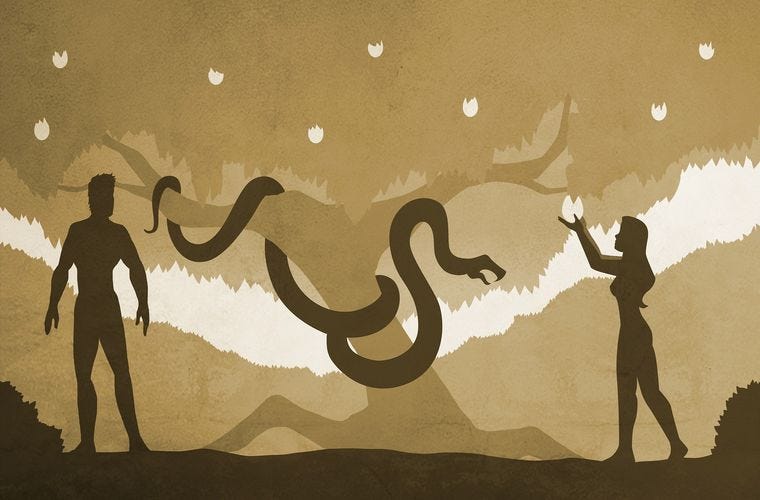
The Word ‘Dinosaur’ Did Not Exist Until 1841, Before then, all large reptiles were called Dragons
And that is interesting. But that is not even the part that got me.
That is the year a British anatomist named Richard Owen coined a brand new word to describe a category of enormous extinct reptiles whose bones were turning up in the rocks. He stitched it together from Greek and announced it to the scientific world, and it stuck so hard that today every child knows it. The word was dinosaur.
Eighteen forty-one. Which means that for the entire span of human language before that year, from the first stories told around the first fires, through ancient Mesopotamia, through the Hebrew of the Bible, through Greece and Rome and medieval Europe and dynastic China, nobody on earth had the word dinosaur. They had no box labeled dinosaur to put a large reptilian creature into.
So what did they call them? When a person in the ancient world saw, or remembered, or carved, or described a large reptile, an animal with the body plan we would now instantly recognize, they reached for the only word they had. They called it a dragon.
Sit with that for a second, because it reframes everything. The word dinosaur is younger than the camera. It is younger than the bicycle. For every single century of human language before it, the only word a person had for a large reptile was dragon.
This is not a small thing, and I want to slow down on it, because it is the hinge the whole essay swings on. It means that the worldwide tradition of dragons, which we have been trained from childhood to file under fairy tale, sits in the exact category that modern science emptied out and relabeled in 1841. The dragons of the old accounts and the dinosaurs of the museum are not necessarily two different subjects. They may be one subject, described by two civilizations that did not share a vocabulary, separated not by truth but by a single word that one of them happened to invent.
And the strange thing, once you start looking, is how specific and how widespread the old accounts are. These are not all flying, fire-breathing storybook monsters. Many of them read like field notes. Cultures with no contact with one another, separated by oceans they could not cross, independently described large reptilian animals in similar anatomical terms, gave them names, ranked them, and in some accounts kept records of encounters with them as though they were cataloguing wildlife rather than inventing legends. When unrelated people on opposite sides of the planet keep drawing the same animal, the simplest explanation is not mass coincidence. It is that there was an animal.
And once you let that possibility sit in your mind, the Bible itself starts reading differently, because the Bible is not shy about these creatures either. The book of Job spends two entire chapters, near the climax of the whole book, where God himself is speaking out of the whirlwind, describing two animals called Behemoth and Leviathan. This is not a throwaway. It is the rhetorical peak of one of the oldest books in the canon, and God’s closing argument is essentially, look at these two creatures, look at what I made.
And look at what he describes. Behemoth has a tail that moves like a cedar, a tree, not a branch, a tree. Its bones are like tubes of bronze, its limbs like bars of iron. It is the first of the works of God, and no man can capture it. Leviathan is worse: armored in overlapping scales sealed so tightly that no air passes between them, a coat of mail no blade can pierce, untamable, unconquerable, the king over all the children of pride. Generations of commentators have tried to shrink these into a hippopotamus and a crocodile, and they have to fight the text the entire way, because a hippo’s tail does not move like a cedar and a crocodile, fearsome as it is, is not the cosmic terror that two chapters of Hebrew poetry insist Leviathan is. The descriptions fit something else. Something larger, older, and gone. The author had a word for it. We translate that word as a guess and move on.
· · ·
So let me put the pieces on the table together, because by now I suspect you have started assembling them yourself.
We are looking for a land animal. Upright. Walking on two legs, with forelimbs it could use. Not enormous, not a monster, something that could share a garden without being a threat. Intelligent enough to earn the label craftiest of all. Capable of complex sound. Comfortable around the first humans. And belonging to a wider family of large reptiles that the ancient world knew and called dragons, and that we have, since 1841, called something else.
There is a branch of that family that fits this profile almost uncomfortably well. The animals on that branch walked upright on two legs, with forelimbs they could use. They were not the apex predators of the nightmares. Many of them were plant eaters and egg eaters, modest in size, a meter or two long, the scale of a large bird or a small deer, the kind of animal that could share a space with a person without the scene becoming a horror film. And if some part of you is already protesting, picturing teeth and claws, picturing a velociraptor loose in a petting zoo, hold that thought for one paragraph, because it answers itself faster than you would expect. The garden was before the fall. The text is explicit that in the beginning every living creature was given green plants for food, and that death and fear and predation are described as things that arrived later, as the furniture of a world that had broken. The teeth that frighten us are not proof of menace in a world that did not yet contain any. We are running the monster movie backward onto a scene that had no monsters in it yet.
And several of them carried something remarkable on their skulls: tall, hollow crests. Now, here is a fact worth holding. In living animals, hollow crests of exactly that kind are not decoration. They are instruments. The casque of a cassowary, the helmet of certain hornbills, the crest of a few other living birds, these hollow structures function as resonating chambers. They take sound and they deepen it, shape it, project it. An animal with a hollow cranial crest is an animal built, physically, to make complex, carrying, modulated sound. The hardware for a voice is sitting right there on top of its head, fossilized in stone, in a creature the rabbis described as standing upright and speaking.
But that is not the fact that should make the hair stand up on your arm. This is.
That same branch, the bipedal, upright, crested branch, is the branch that birds came from. Not metaphorically. Not loosely. Birds are, in the most literal anatomical sense, the living members of this exact family. The sparrow at your window and the creature in the garden are leaves on the same limb of the tree.
Now think about what birds can do with sound. A mockingbird can reproduce a car alarm. A lyrebird can imitate a chainsaw, a camera shutter, the call of every other bird in the forest. A parrot can be taught to say words, real human words, in a real human language, with a vocal organ that no mammal possesses and no other reptile ever evolved. The most gifted mimics of human speech alive on the earth today are not our fellow mammals, not the apes with whom we share so much. They are birds. They are the surviving cousins of the very animals we are talking about.
And the hardware goes deep into the lineage. In 2016, paleontologists reported something they had never found before: a fossilized syrinx, the specialized vocal organ that lets birds produce their astonishing range of sound, preserved in a bird called Vegavis that lived right alongside the last of the great extinct reptiles, in the deep past, in the age of so-called dinosaurs. The voice-making equipment was already there, already present in this branch, that long ago.
Let me be careful and honest about exactly what that does and does not prove, because this is the spot a hostile reader will pounce, and I want to take the weapon out of his hand before he reaches for it. We do not have a fossil of a talking animal. We never will, and I will not pretend otherwise. The soft tissue of a throat, a tongue, a vocal organ, almost never survives the journey into stone. That cuts both ways: it means we cannot prove these creatures spoke, and it means no one can prove they could not. Their silence in the fossil record is the silence of biology that rots, not the silence of biology that was absent.
So here is the claim, stated as narrowly and as carefully as I can make it. Of all the branches of the entire reptile family, every lizard, every snake, every turtle and crocodile that ever lived, there is exactly one branch where the equipment for complex, speech-like sound has any precedent at all. One. And it is the very same branch that already matched the posture, the size, the upright stance, the usable forelimbs, the intelligence, and the easy company-keeping that the text of Genesis and two thousand years of rabbinic tradition independently describe. Every arrow, from the Hebrew, from the Talmud, from Josephus, from the anatomy, from the living birds, points at the same small patch of the tree of life.
· · ·
Now I owe you the objection I told you to hold onto, the strong one, the one a sharp reader has been shouting at the page for several paragraphs. The serpent is the devil. The New Testament says so, in plain words. So why on earth are we talking about biology at all?
Here is my answer, and it is the distinction I asked you to keep in your pocket all the way back at the beginning. A spiritual agent acting through an animal does not erase the animal. Elsewhere in the same scriptures, when a donkey is made to speak, it is still a real donkey standing in a real road. When a staff is thrown down and becomes a serpent before Pharaoh, it becomes a real serpent. An agent using a creature still leaves you holding the question of what creature it used. The devil reading and the animal question are not rivals fighting over the same chair. They are two floors of the same building. You can believe every word about the spiritual adversary, the real tempter behind the scene, and still ask, with complete honesty, what the thing in the grass had been before it was in the grass. The one does not dissolve the other. It sits on top of it.
· · ·
So here is the composite, the whole picture, assembled from the text, the tradition, and the rock.
A creature that stood upright in a garden where nothing yet feared anything. Forelimbs like hands. A crest that let it shape sound into something like words. The sharpest mind of all the animals, sharp enough that when it spoke, the woman did not flinch, she simply listened. It was not a horror. In a world still whole, it may have been one of the most magnificent things in it. Beautiful, even. Articulate. At ease among the only two people alive.
And then it chose the one thing it should not have, and said the one sentence that broke the world, and the judgment that fell on it was not only punishment. It was erasure. On your belly you shall go. The upright posture, gone. The hands, gone. The voice that had shaped an argument, gone, reduced to a hiss. The magnificent thing was pressed down into the dust it would now eat, stripped of everything it had been, until all that remained for the next ten thousand years of human memory was the low, legless, voiceless shape sliding through the grass.
We have spent the whole of human history staring at what it became. Almost nobody has stopped to grieve what it was.
That, to me, is the part that turns this from a clever puzzle into something that aches a little. The oldest story we have is not only about a man and a woman and a tree. It is also about a creature that was once upright and articulate and beautiful, and that lost all of it in a single afternoon, and that we have remembered ever since only by the shape of its punishment. We named it by its sentence. We forgot it had a life before the verdict.
· · ·
I told you at the start I would keep one word out of this for a while, and you have it now, and you can do with it whatever you like. Call it a thought experiment. Call it heresy. Call it the most fun I have had reading three chapters I thought I already knew by heart.
But I will leave you with the thing I cannot stop turning over. We read the garden story as the account of how we fell. And it is. But buried inside it, in a single cursing sentence we stopped hearing centuries ago, there may be the record of another fall entirely. A creature that was there at the beginning, that walked and spoke and chose, and that paid for the choice by losing its very shape.
And if that is true, then the snake in every painting, on every Sunday school felt board, coiled around every tree in every children’s Bible, is not the character at all. It is the scar left where the character used to be.
There is a name for what it might have been, before. I have my candidate. But I think the better question, the one I would actually like to leave you holding, is not what species it was.
It is this. If the most beautiful creature in the garden could be reduced to the thing we step over in the grass and never think about again, what does that tell you about the size of what was lost that day? And what does it tell you about the One who, even in the cursing, was already promising to put it right?
· · ·
If you value unflinching, historically grounded analysis that mainstream outlets soften or ignore, consider upgrading. Paid subscribers get:
Several new, full-length articles every week.
Carefully researched pieces you won’t find elsewhere.
Full access to the complete premium archive
Archive of in-depth writing, research, and commentary — all in one place.
Entry into the subscriber chat
A private space for serious readers and thoughtful discussion.
Thanks for reading. This post is public, so feel free to share it. A. C. Rosenthal writes on comparative religion, Islamic theology, and the relationship between Christianity and modern Western culture. This work is entirely reader-supported. By choosing a paid subscription, you allow me to continue this long-form research to bring these vital stories to light. Thank you for helping this Lion roar for truth. His book The Two Muhammads is available now. Further analysis at:

acrosenthal.com/
https://thetwomuhammadscurriculum.thinkific.com/
A note on sources, for the curious and the skeptical
Biblical and Rabbinic
Genesis 1-3; Numbers 22; Job 40-41; Revelation 12, 20 (ESV)
Talmud Bavli, Tractate Sotah 9b (on the original posture of the serpent)
Genesis Rabbah 19:1; 5:9 (on the pre-fall nachash and dietary change)
Pirke De-Rabbi Eliezer, Chapter 13 (physical description of the serpent)
Josephus, Antiquities of the Jews, I.1.4 (the walking, speaking serpent)
Zohar 1:35b (Samael and the nachash)
Scientific and Paleobiological
Clarke, J.A. et al. (2016). ‘Fossil evidence of the avian vocal organ from the Mesozoic.’ Nature, 538, 502-505. [Vegavis syrinx discovery]
Novas, F.E. et al. Various papers on oviraptorid cranial crests and avian-theropod vocalization.
Witton, M.P. (2018). The Palaeoartist’s Handbook. Manchester University Press.
Sarfati, J. (2014). The Genesis Account. Creation Book Publishers. [YEC exegesis of Genesis 1-3]
Menton, D. and Gilmer, A. ‘What Were Behemoth and Leviathan?’ Answers in Genesis. [answersingenesis.org]
Hovind, K. (various). Creation Seminar series, Parts 1-7. CSE Ministries.
Linguistic
Brown, Driver, Briggs (BDB). Hebrew and English Lexicon of the Old Testament. Entry: nachash (H5175).
Gesenius, W. Hebrew Grammar. Entry: root n-ch-sh and semantic range.
I show my work on purpose, so you can check it rather than take my word. The serpent’s original posture: Talmud Bavli, Sotah 9b; Genesis Rabbah 19:1; Pirke De-Rabbi Eliezer ch. 13; Josephus, Antiquities of the Jews I.1.4. The pre-fall plant diet for all creatures: Genesis 1:29-30. Behemoth and Leviathan: Job 40 and 41. The serpent identified with the adversary: Revelation 12:9 and 20:2. The coining of the word Dinosauria by Richard Owen: 1841. The fossilized syrinx in the bird Vegavis iaai, showing complex vocal hardware in this lineage in deep time: Clarke et al., Nature, 2016. The Hebrew root n-ch-sh and the word arum: standard lexicons, Brown-Driver-Briggs and Gesenius. Everything above is checkable. I would rather you checked it than believed me.
Best thing I've read in ages. I should resist the temptation to shout Big Bird!
This is one of the sharpest pieces of textual close-reading I have encountered on this question. The cursing-sentence observation is exactly right and almost nobody sits with it properly — you do not sentence a creature to crawl unless it was doing something else. The ancient readers saw it, the rabbinic tradition said it plainly, and then two thousand years of artistic convention buried the pre-cursor creature entirely under the image of its punishment.
Your distinction between the agent and the animal is the essay's most important structural move. The devil reading and the biological question are not rivals. They are two floors of the same building, and collapsing them is what has kept the biological question invisible for so long.
I want to flag one place where I think the essay and a piece I have been developing arrive at the same destination from different directions. You approach the question from inside the text — through the Hebrew, the rabbinic tradition, the cursing sentence as demotion. I approached it from outside — through the 1842 Owen coinage and the nomenclature problem it creates. Neither of us had read the other's work when the arguments converged, which is exactly the kind of independent convergence the hypothesis would predict if it is tracking something real.
One point I would add to your framework: the Narmer Palette creatures that creationists frequently invoke as cross-cultural evidence are not straightforward long-necked reptilian depictions. Standard Egyptological analysis identifies them as serpopards — composite leopard-serpent hybrids in a kingship context. The creationist's star exhibit misidentifies a mythological composite as a sauropod, which further dismantles the coexistence argument without requiring any alternative identification of the Genesis creature.
The closing image is the one that leaves a mark. We named it by its sentence. We forgot it had a life before the verdict. That is the essay's permanent contribution regardless of how far the biological hypothesis eventually goes.