The Queen They Dethroned
What gave early scientists the faith that their experiments would or could produce consistent results?

There is a building in Bologna, Italy, that has been continuously operating as a university since 1088. It has survived plague, war, political revolution, the fall of empires, and the rise of the secular state. For most of its history, the discipline that sat at the top of its academic hierarchy, the one that all other disciplines were understood to serve and to which they were all ultimately answerable, was theology. The queen of the sciences, they called it. Not because theologians were the most powerful people in the room, though sometimes they were. Because the question theology asked, what is real, what is good, what is this all for, was the question that gave every other question its meaning.
They dethroned her in the nineteenth century. They told themselves they were cleaning house, removing superstition from the temple of reason, liberating inquiry from the dead hand of dogma. What they did not notice, because it takes generations to notice this kind of thing, is that when you remove the question that orients all the other questions, you do not get purer science. You get science without a compass. You get inquiry without a destination. You get the most technically proficient, directionally lost institution in human history.
We are living in that institution now. And the bodies it keeps producing, not just literal bodies, though those too, but the moral wreckage, the civilizational drift, the narrowing of human possibility dressed up as its expansion, are the predictable output of a machine that was stripped of its governing question and told to run faster.
This article is an argument. It is aimed specifically at the person who believes theology is the least scientific thing in the room, the person who thinks the medieval university was a monument to ignorance that modernity had the good sense to dismantle. I want to make the case that the dismantling was the catastrophe. That the queen was not a tyrant. That her exile has not liberated the sciences but orphaned them. And that what passes for intellectual progress in the modern university is, in significant measure, the sound of very smart people running very fast in very tight circles, because the question that would have told them where to go was the first thing they threw out.
*
The Architecture of the Medieval Mind
Before making the argument, it is worth understanding what was actually being claimed when theology was called the queen of the sciences. The claim was not that theologians knew more than physicists or that prayer was a substitute for experiment. The claim was architectural. It was a claim about the structure of knowledge itself.
The medieval university was built on a specific premise: that all genuine inquiry is ultimately asking a version of the same question. Physics asks how matter behaves. Chemistry asks what matter is made of. Medicine asks how the body works. Law asks how human society should be ordered. Philosophy asks what is real and what is good. And theology asks why there is something rather than nothing, what the whole of it is oriented toward, and what it means for a human being to live well inside it.
These questions are not equal in the sense of being the same kind of question. They form a hierarchy. The lower questions depend on the higher ones for their ultimate justification. You cannot ask how matter behaves without a prior commitment to the idea that matter behaves in consistent, investigable ways, which is itself a theological proposition. The orderliness of the universe is not something physics discovers. It is something physics assumes. And the history of that assumption leads directly to a specific intellectual tradition rooted in a specific doctrine of creation: that the universe was made by a rational God who embedded rational order into it, and that human minds, made in the image of that God, are capable of reading that order.
Alfred North Whitehead, who was not a Christian apologist but one of the twentieth century’s most rigorous philosophers of science, made this point in a way that has never been adequately answered. He argued that modern science was not possible without the medieval theological conviction that nature was the product of a rational Creator. That conviction, he said, is what gave early scientists the faith that their experiments would produce consistent results, that the universe would not simply do something different tomorrow, that there were laws to discover rather than merely patterns to catalogue. Strip that conviction and you have not liberated science. You have removed the foundation on which the entire enterprise rests.
This is what the medieval hierarchy of knowledge was protecting. Not power. Not institutional privilege. The coherence of inquiry itself.
When theology sat at the top, every discipline was required to ask not just how but why. The physician was not only asking how to treat the body. He was asking what the body was for, what a human being is, what healing means in the context of a life that has a destination. The lawyer was not only asking what the statute said. He was asking whether the statute was just, which required a standard of justice that no statute could supply from within itself. The natural philosopher was not only asking what the evidence showed. He was asking what kind of universe was the sort of thing that could produce evidence, and what kind of mind was the sort of thing that could read it.
These are theological questions. They were not obstacles to inquiry. They were the questions that made inquiry meaningful.
*
What Happened When She Left
The expulsion of theology from the center of the university did not happen all at once. It happened in stages, and each stage was accompanied by a plausible-sounding justification.
First, theology was demoted from queen to peer. It became one department among others, subject to the same methodological standards as chemistry or economics, which meant it was immediately disadvantaged, because the methods appropriate to chemistry are not the methods appropriate to questions about ultimate meaning. You cannot run a double-blind trial on the existence of God. The methodological displacement was dressed up as fairness but functioned as elimination.
Then, as theology lost institutional authority, the organizing question it had asked lost institutional standing. The disciplines were no longer required to justify themselves to anything outside their own methods. Physics justified itself to physics. Economics justified itself to economics. Each field became increasingly self-referential, increasingly sealed off from the questions that would have connected it to human meaning and moral purpose.
What followed was exactly what you would predict. The disciplines proliferated. The sub-disciplines multiplied. The papers accumulated. But the generative thinker, the person who could stand above the disciplines and see across them, became rarer and more suspect. Interdisciplinary work was celebrated in theory and rewarded almost nowhere in practice, because the institution had no framework for evaluating ideas that could not be assessed within a single discipline’s methodological standards.
The result is what you described: derivative work and cumulative work. More data confirming what is already believed. Existing methods applied to adjacent problems. The generation of knowledge without the generation of wisdom. The production of answers to questions that no one has interrogated to determine whether they are the right questions.
This is not a failure of intelligence. The modern university contains some of the most intelligent people who have ever lived. It is a failure of orientation. The instruments are extraordinarily fine. The compass was thrown out with the theology.
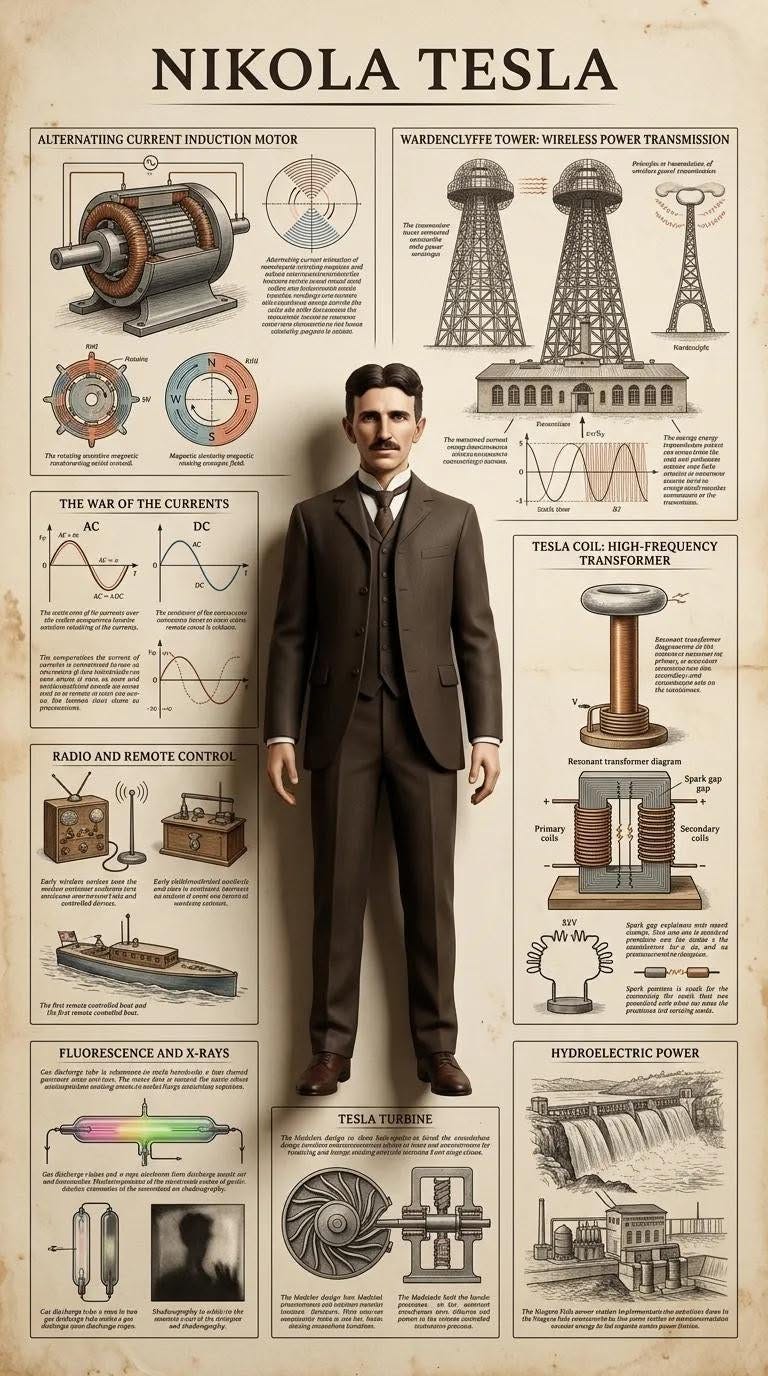
Tesla and the Altitude Problem
Nikola Tesla demonstrated radio-controlled craft on the Hudson River in 1898. He stood in Madison Square Garden and steered a small boat by remote control in front of a live audience. They thought it was a trick. A trained monkey, some of them said. They had no framework for what they were watching.
He tried to sell the concept to the United States Navy as an autonomous torpedo. They were not interested.
What Tesla was actually doing was thinking about the nature of electromagnetic energy and what the principle of wireless transmission made possible. The drone was not his project. It fell out of his project the way fruit falls from a tree. He was not solving the drone problem. He was asking a question so large that the drone was an incidental answer to it. He thought commercial radio was a quaint application of what he had built, a parlor trick dressed up as communication, because his mind was running at an altitude where the interesting questions were about transmitting power across the planet without wires.
That altitude is what the governing question produces.
