What Will You Buy?
"I would buy Truth, if you have it to sell."

Late last night I was reading several posts by Dan Burmawi , one after the next, and I could not help but have the same question playing back and forth in my head. "What will you buy? What will you buy?"
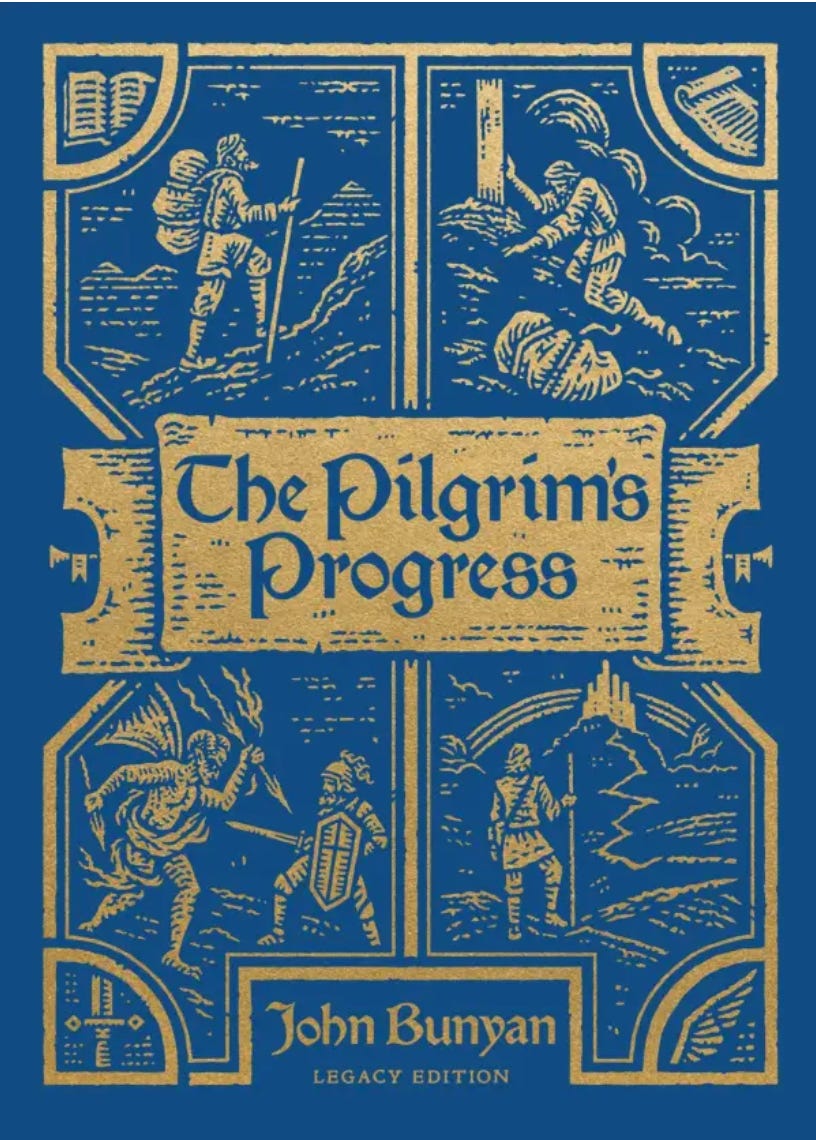
It is the question asked of Christian and Faithful in John Bunyan’s Pilgrim’s Progress, the book that has sold more copies than any other in the English language except the Bible itself, written by a man who spent twelve years in a Bedford jail for the crime of preaching without a license and used the time to produce one of the most accurate maps of the human condition ever committed to paper. Bunyan wrote it in the seventeenth century. He was describing the eighteenth, and the nineteenth, and the twentieth, and ours. The man had the particular gift of the genuine prophet, which is not the ability to predict specific future events but the ability to see the permanent structure of human experience clearly enough that every generation finds itself described in it.
Christian and Faithful had not arrived at Vanity Fair easily. They had left the City of Destruction behind them, which cost them everything they had known, every comfort and familiar face and social belonging that the city offered in exchange for the agreement not to ask certain questions. They had passed through the Wicket Gate, which required a kind of humility that the proud find unbearable. They had endured the Slough of Despond, that particular bog of discouragement that swallows people who have just made the most important decision of their lives and finds them suddenly without the energy they expected to feel. They had climbed the Hill Difficulty. They had passed through the Valley of the Shadow of Death, where the path was narrow and the darkness on either side was absolute and the only way through was to keep moving and trust that the path continued even when it could not be seen. They had survived the castle of Giant Despair, who captured them and beat them and told them they would never get out, and they escaped not by overpowering the giant but by remembering a key they had been carrying all along, the key of Promise, which the giant’s locks could not resist.
After all of that, they came to Vanity Fair.
Bunyan’s description of the Fair is worth reading in full because it is one of those passages that lands differently depending on the century you read it in, and in our century it lands like a diagnosis. The Fair has been running, Bunyan tells us, since time out of mind. It was set up by Beelzebub and Apollyon and Legion and their companions when they discovered that the path to the Celestial City ran directly through the town of Vanity, and rather than try to block the path they established a permanent market alongside it. Everything is for sale. Houses, lands, trades, places, honours, preferments, titles, countries, kingdoms, lusts, pleasures, and delights of all sorts. There are jugglers, cheats, games, plays, fools, apes, knaves, and rogues of every description. There are rows and rows of merchandise, organized by nation, and the streets are named after the things being sold: the Britain Row, the French Row, the Italian Row, the Spanish Row, the German Row. And there is a special row called the Row of Rome, where the wares are particularly popular and particularly well-presented.
When Christian and Faithful walked through the Fair, they created a disturbance. Not because they were loud or aggressive or confrontational. They created a disturbance simply by being what they were. They were dressed differently from the merchants and the buyers. They did not speak the language of the Fair, and when the merchants tried to engage them they replied in the language of Canaan, which the Fair did not recognize and found irritating. And when the merchants pressed their wares on them, gestured at the displays, offered the deals that everyone else was accepting, Christian and Faithful said: we buy the truth.
That answer got them arrested. It got Faithful killed. The Fair could not tolerate the presence of people who had decided in advance what they were there to buy, who had looked at everything on offer and named it accurately and declined it, who had said out loud that the one thing they were looking for was the one thing the Fair did not stock and had never stocked and would never stock because truth is not a product that generates the kind of margin the Fair requires.
We buy the truth. Four words. The most dangerous sentence available in a marketplace built on the premise that truth is either unavailable or irrelevant or infinitely negotiable depending on who is selling and what the current price of social belonging requires.
Look at the Fair as it operates today and tell me Bunyan was writing history rather than prophecy.
The merchandise has been updated. The technology is new. The rows have different names and the jugglers and cheats have verified accounts and book deals and speaking fees. But the structure is identical and the question being asked at every stall is the same one it has always been. What will you buy? What are you willing to accept in exchange for your attention, your agreement, your silence, your complicity? What will you trade for belonging in this particular row of the Fair? What will you pretend not to notice in exchange for not being the one the crowd turns on this week?
The official press is one of the most elaborately constructed stalls in the contemporary Fair, and it sells a particular product with particular efficiency. The product is not information. Information is the packaging. The product is the management of what questions are permitted, what conclusions are available, what facts are allowed to exist in public without being immediately surrounded by the apparatus of dismissal and delegitimization that the Fair deploys against anything that threatens its preferred inventory. The traditional official press would, as I have said before, crucify you in the public square for speaking truth plainly and without apology, and they would do it not out of malice, most of them, but out of the sincere conviction that the Fair’s inventory represents reality and that anyone offering something not stocked in the Fair’s rows is either confused or dangerous or both.
This is not a new problem. It is the oldest problem. Faithful was killed at Vanity Fair for the crime of saying plainly what he saw. Socrates was given hemlock for the crime of asking questions the city of Athens had decided were impermissible. The Hebrew prophets were beaten, imprisoned, thrown into cisterns, and sawn in two for the crime of reporting accurately on what was happening to a nation that preferred the comfort of official reassurance to the discomfort of honest accounting. The pattern is so consistent across so many centuries and so many different cultural contexts that it amounts to something close to a law: the Fair always persecutes the people who decline to buy what it is selling, because their refusal is itself a statement about the value of the merchandise, and that statement cannot be permitted to stand.
What has changed in our moment is not the structure of the Fair but the availability of an alternative. For most of human history, the official channels of communication were the only channels available to most people. The scribes controlled the manuscripts. The guilds controlled the printing presses. The newspapers controlled the distribution networks. The broadcasters controlled the airwaves. If the Fair owned those channels, and it generally did, then the Fair’s inventory was the only inventory most people ever encountered, and the question of what else might be available simply did not arise for most of them most of the time.
That monopoly is broken. It is not completely broken and the Fair is working very hard to repair it through a combination of platform regulation, algorithmic suppression, advertiser pressure, and the coordinated social punishment of people who use the new channels to say things the Fair finds inconvenient. But the monopoly is broken enough that the alternative exists. You have to dredge for it. You have to go looking in places that do not announce themselves, in the new media and the alternative outlets and the writers who have decided that the cost of saying true things plainly is worth paying even when the Fair sends its officers to make the cost as high as possible. You find it in drips and drabs, fits and starts, one writer and then another and then another, and you are genuinely grateful when you find it because you know what it cost the person to put it there.
This is not a comfortable place to live intellectually. The people who have decided to buy truth rather than the Fair’s preferred merchandise do not form a coherent ideological bloc that you can join and be comfortable. They disagree with each other on important things. They come from different traditions and different political backgrounds and different religious commitments and different cultural contexts, and the only thing they reliably share is the refusal to let the Fair’s inventory management determine what they are allowed to notice and say. That shared refusal is enough for a conversation but it is not enough for a tribe, and the absence of a tribe is one of the things the Fair uses most effectively against the people who decline its offer. Belonging is expensive in a marketplace built on social currency, and the Fair sets the price of truth very deliberately at the cost of belonging, because most people will pay almost any price to avoid the specific loneliness of being the one who said the thing that the crowd decided was unsayable.
Christian and Faithful walked through the Fair and created a disturbance by existing. Not by being aggressive. Not by attacking the merchants or tearing down the stalls. Simply by being visibly, recognizably, uncomplicatedly not for sale. That visibility was the disturbance. It is always the disturbance. The Fair can accommodate almost anything except the person who looks at everything on offer and says, clearly and without drama: none of this is what I came for.
Faithful paid for that refusal with his life, which Bunyan does not soften or resolve into a comfortable ending. He is tried at Vanity Fair by a jury whose members are named Blindman, Nogood, Malice, Lovelust, Liveloose, Heady, Highmind, Enmity, Liar, Cruelty, Hatelight, and Implacable, and he is convicted and executed. Bunyan’s point is not that truth-telling is safe or that the Fair eventually rewards the courageous. His point is that Faithful goes directly from the execution in Vanity Fair to the Celestial City, carried by a chariot and horses, bypassing the rest of the journey entirely, while Christian escapes and continues the long road alone. The martyrdom is not a tragedy in Bunyan’s accounting. It is a promotion. But it is still a martyrdom and Bunyan does not pretend otherwise.
Most of us are not being asked to pay that price. The Fair in our moment extracts its costs in smaller currency: social exclusion, professional consequences, the low-grade permanent anxiety of knowing that the thing you said accurately and honestly is circulating among people who have decided that accuracy and honesty are threats to be managed rather than virtues to be honored. These are real costs. They are not Faithful’s cost. But they are real and the Fair knows how to use them and the question of whether you are willing to pay them is not a trivial one.
Which brings it back to you, reading this right now. Not as a rhetorical flourish but as an actual question that deserves an actual answer, at least internally, at least honestly, in the part of yourself that the Fair does not have access to.
What will you buy?
Not in the abstract. Not in the comfortable hypothetical where the cost is someone else’s to pay. Right now, in the specific situation you are actually in, with the specific relationships and professional dependencies and social memberships that make certain truths expensive for you specifically to say or agree with or pass along.
When the merchant leans across the stall and offers you the version of events that everyone in your row has agreed to accept, the version that requires you to not notice certain things or not say certain things or not ask certain questions, what do you reach for?
When the crowd turns on someone for saying a true thing in a way the Fair found inconvenient, and the social pressure to join the turning is immediate and palpable and the cost of not joining is visible in real time, what do you do?
When the algorithm offers you the comfortable content and the affirming content and the content that confirms what you already believe and asks nothing of you, and the uncomfortable content is three links deep in a direction nobody recommended and might cost you something to be seen engaging with, which direction do you go?
These are not questions about grand heroic moments. They are questions about the ten thousand small purchases that add up, over a lifetime, to the person you have become. Every small purchase in the direction of comfort and belonging and the path of least social resistance is a small purchase of the Fair’s inventory. Every small refusal, every moment of declining to pretend, every quiet insistence on saying the accurate thing even when the convenient thing was available, is a small purchase of truth.
Faithful said: we would buy truth. Four words that got him killed by a jury of twelve people whose names are the permanent inventory of the Fair’s enforcement arm.
The Fair is still open. The jury is still seated. The question is still being asked at every stall, in every row, in every transaction of attention and agreement and silence that the day presents.
What will you buy?